Italian

Today’s journey takes us to Turkey, where Ephesus is the third chapter


The column “Art, Culture, History and Archeology” curated by Carlo Franchini continues. A journey to discover the beauties, curiosities, and charm of Italy and the world, of yesterday and today.


Texts, photos, and videos by Carlo Franchini
Traveling to Turkey is a journey that never ceases to amaze. Istanbul, Pergamon, and then Ephesus. A continuous succession of wonderful testimonies of the ancient world. Along the journey that will take us to Ephesus, I observe the beautiful and lush countryside we are crossing. The first stop, almost at the gates of the ancient city of Ephesus, is where the first basilica dedicated to the Virgin Mary was located, believed to have lived here during the last years of her life. But what does the Virgin Mary have to do with Ephesus? “…Therefore, when Jesus saw his mother, and the disciple whom he loved standing nearby, he said to his mother, ‘Woman, behold, your son!’ Then he said to the disciple, ‘Behold, your mother!’ And from that hour, the disciple took her to his own home.” [1]
According to tradition, Mary arrived in Ephesus accompanied by St. John to escape the continuous persecutions of Christians in the Holy Land and in compliance with the will of Jesus. Thus, Christians decided to build a basilica in the 3rd century, which would acquire significant historical importance for the Christian religion. It is in fact in the Basilica of the Virgin Mary in Ephesus that the 3rd Ecumenical Council took place in 431 AD, also known as the “Council of Ephesus,” which established that the figure of Christ was that of a man and the Son of God, and that the Virgin Mary had given birth to “not a man but God as man.”[2]
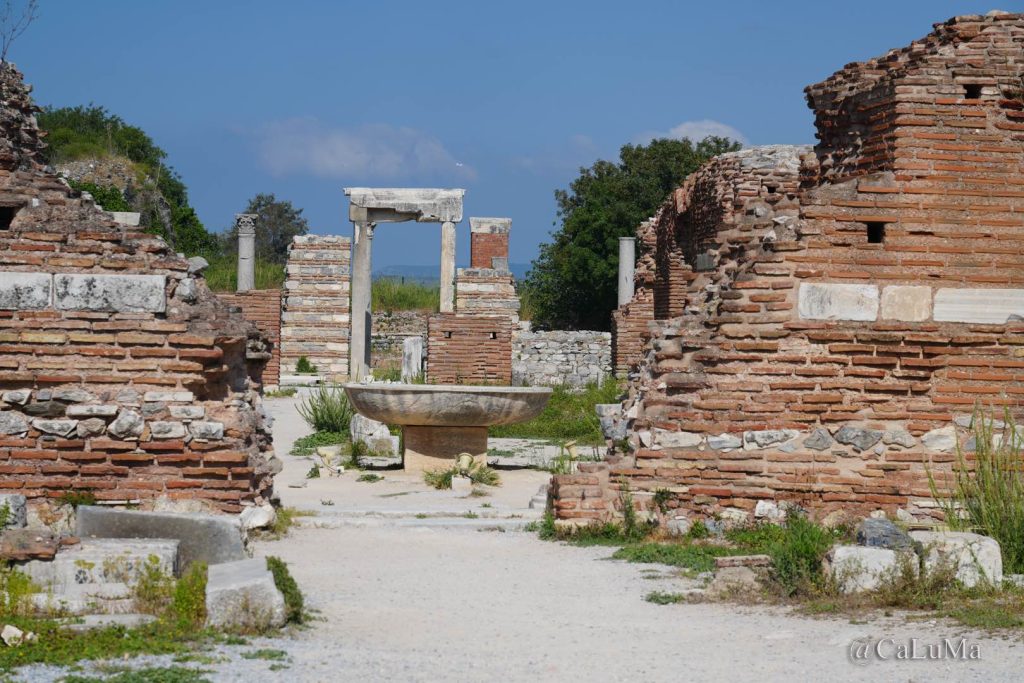
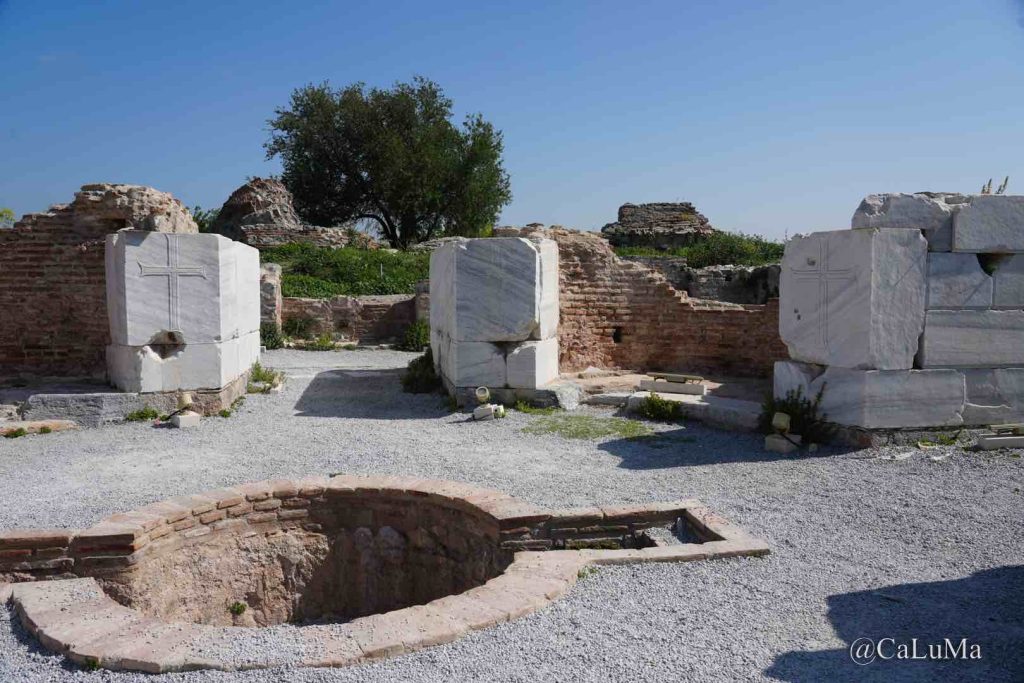
We wander among the ruins of the Basilica of Mary Mother of God where precious engravings of crosses on marble, ancient walls, and a spectacular baptistery stand out. The atmosphere is mystical and silent, interrupted only by the gentle blowing of the wind and the chirping of some birds. I can’t help but think about the turbulent council, the clamor, maybe even the shouting from how heated the discussion was, the people outside waiting to know, the passage of time marking a new stage in the journey of the Christian religion. A little further down the road and the ancient city of Ephesus appears, a UNESCO World Heritage Site since 2015.
Inhabited originally by the Hittites, a population from Anatolia, it was colonized by the Ionians around the 2nd millennium B.C., invaded by the Persians of Cyrus the Great and then liberated by Alexander the Great in 334 B.C. But the struggles for Ephesus were not over. Devastated this time by the Goths in 263 A.C. it regained strength only in the 4th/5th century B.C. Ephesus was famous for the devotion to Artemis (Diana for the Romans) [3] and for the temple built in 550 B.C. and dedicated to the goddess, considered one of the seven wonders of the ancient world.
At that time it was right on the Aegean Sea and became an important commercial port. In 129 BC it became part of the Roman Empire and the capital of the Roman provinces of Asia Minor. It is believed that Ephesus was, after Rome and Alexandria in Egypt, the third most important city in the ancient world.
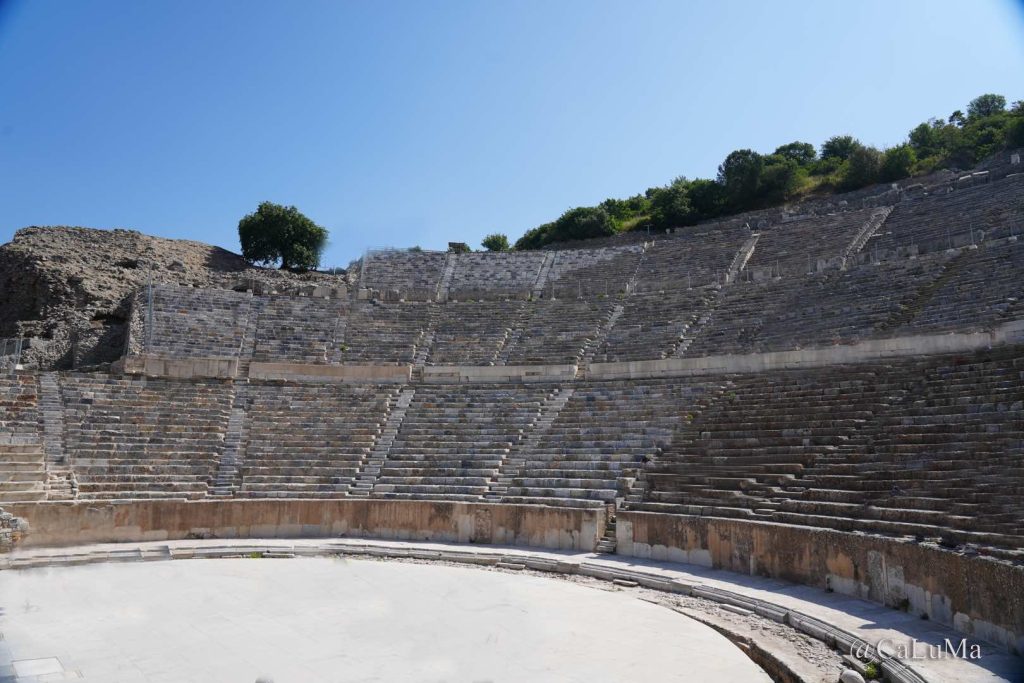
Under the Roman Empire, Nero expanded the port, while Hadrian and Domitian built impressive palaces with refined style.Let’s start the visit to the site with the Grand Theater, a wonderfully preserved piece of architecture believed to have been built at the end of the 1st century A.D. It could accommodate up to 25,000 people. As I climb the steps and look down from above, it’s not hard to imagine the life that flowed around the theater and inside during the performances. The noise of the chariot wheels, which with their comings and goings have left indelible traces on the marble slabs of the street, the chatter of the spectators during the shows, and certainly the music!
Let’s walk along the Marble Road that leads from the Grand Theater to the famous Library. The road paved with marbles is flanked by well-aligned walls that delimit the street. Every so often, there are some low reliefs depicting a helmet, a sword, a deity. A column bears the edict of the governors Eutropius and Festus for the reconstruction of Ephesus following the earthquake of Nicomedia in 365 AD. This site has been meticulously and engagingly rearranged, as well as the restorations of statues and monuments. At the end of the street, here is the Library of Celsus in all its majesty. It was erected in 114 AD [4] by the son Gaius Julius Aquila in honor of his father Tiberius Julius Celsus Polemaeanus, governor of Asia, and it is also his mausoleum. The tomb of the proconsul is right under the base of the library.
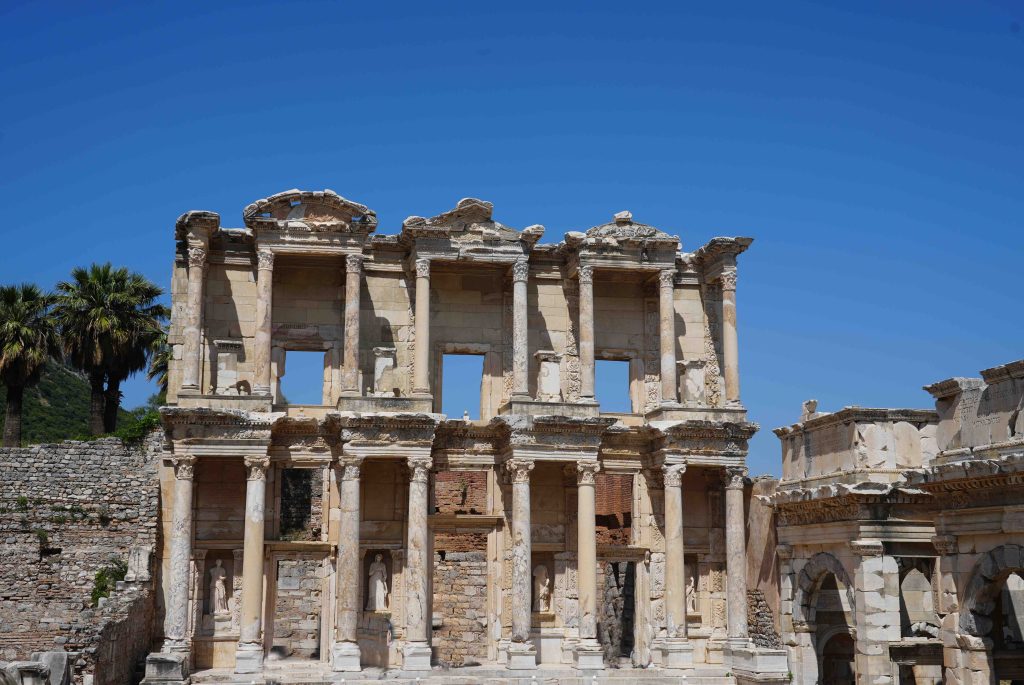
The two-storey monument supported by columns with wonderful capitals is adorned with reproductions [5] of extraordinary marble statues representing the four Greek virtues: Sophia (wisdom), Areté (virtue), Episteme (knowledge), and Ennoia (intellect). Among the niches arranged on the walls, over 12,000 papyri were kept. A significant number, and certainly the Library of Celsus, after those of Alexandria and Pergamon, was the most important in the ancient world.
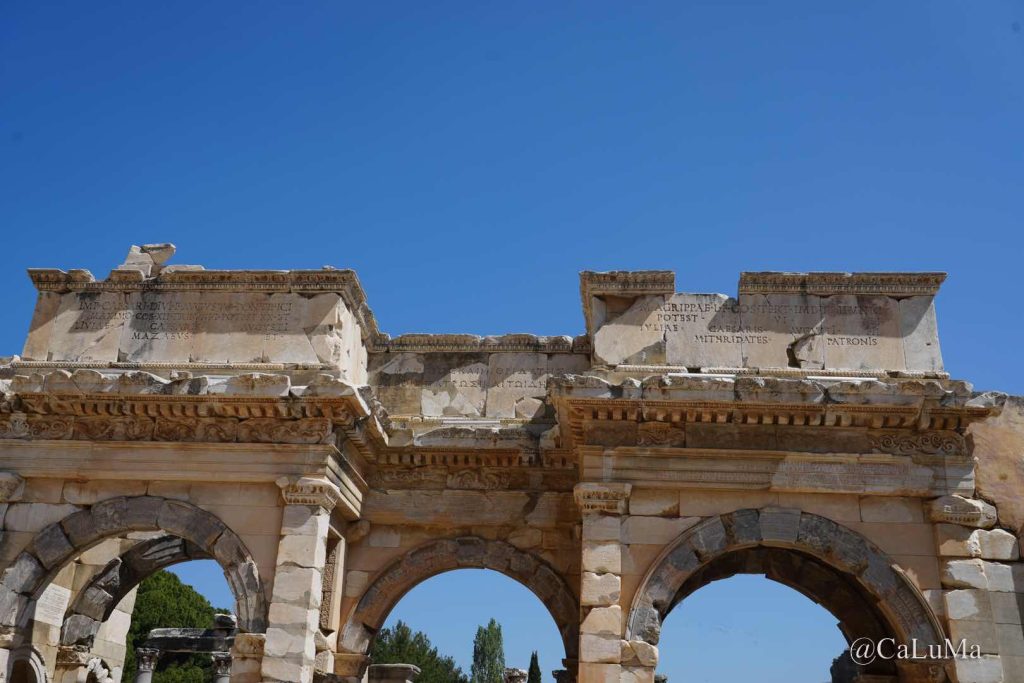
Let’s continue to the Porta di Augusto and then arrive at the beautiful temple of Hadrian, which was in Ephesus in 128 AD, where a decoration depicting Medusa and the Amazons stands out. According to the historian Strabo, Ephesus was founded by one of the Amazon queens, the warrior women who were said to be descendants of the god Ares.
Every corner is a magic. Everywhere refined low reliefs from the Roman era are exposed, engravings, sculptures, like that, for me spectacular from the 2nd century AD depicting Niche, the goddess of victory.
In the 1st century AD, with the arrival of Saint Paul in 53 AD, Christianity took over in Ephesus, and subsequently Saint John became the successor and representative of the church of Ephesus after the martyrdom of Saint Paul.
And it is precisely in what was the basilica of St. John that we move, near the present-day town of Selcuk. The ruins give the impression that it was a basilica of large dimensions and particularly impressive. You can clearly see the central nave and the imposing entrance. It was built by order of the Emperor Justinian right on the tomb of St. John.
The last visit, but not for importance, is the small house where it is believed the Virgin Mary lived until her death, a few kilometers away.
Along the road on the right there is a large cavern that legend has it is that of the seven sleepers… ” Legend has it that in 250 A.D., during a trip of the emperor Decius in the East, 7 Christians from Ephesus who refused to worship pagan deities were condemned. However, they managed to escape and hide in a cave on Mount Celion. One of them would go daily to the market to buy food, but they were discovered, and the emperor ordered them to be walled up alive in the cave where they had taken refuge. The 7 prepared to die but fell into a deep sleep. When they woke up, they saw that they were surrounded by curious people. A farmer had opened the cavern to shelter his livestock. The 7 thought they had only fallen asleep the day before, so one of them went to the market to buy provisions. But when he pulled out the silver coins to pay for the food, the vendors were astonished. They were brought to the bishop and realized that they had slept for 2 centuries… and were a testimony to the resurrection of the bodies. They perished on the same day and, awaiting the final resurrection, were buried, by order of the emperor Theodosius II, covering the tomb with golden stones.” [6]
Finally, we reach Meryem Ana Evi, the House of Mary, which is a sacred place for Christians but also for Muslims who have devotion and respect for the mother of Christ, who is also mentioned in surah 19 of the Quran.
In the middle of a forest of lush trees stands a small brick house that is the destination of continuous pilgrimages. There is not much to see, but the atmosphere is suggestive. Inside, a small chapel houses, above the altar, a statue of the Virgin Mary, and it is here that the Mother of Jesus lived her last years, taken to safety in Ephesus from the persecutions of Christians in the Holy Land, by St. John.
It was in 1891 that archaeologists, following precise indications from the visionary nun, now blessed Anna Katharina Emmerick [7] who had continuous visions of the place where Mary had lived, dug and found the house that was brought to light. On the wall next to the church, thousands of votive notes from faithful of all religions who visit this sacred place every year are displayed.
Despite the many people waiting in line to enter, there is silence. A deep silence that invites reflection, I believe regardless of one’s religious beliefs. Once again, it is the rustling of the wind through the leaves of the tall trees the only sound that is perceived. But it’s time to go, the adventure continues!
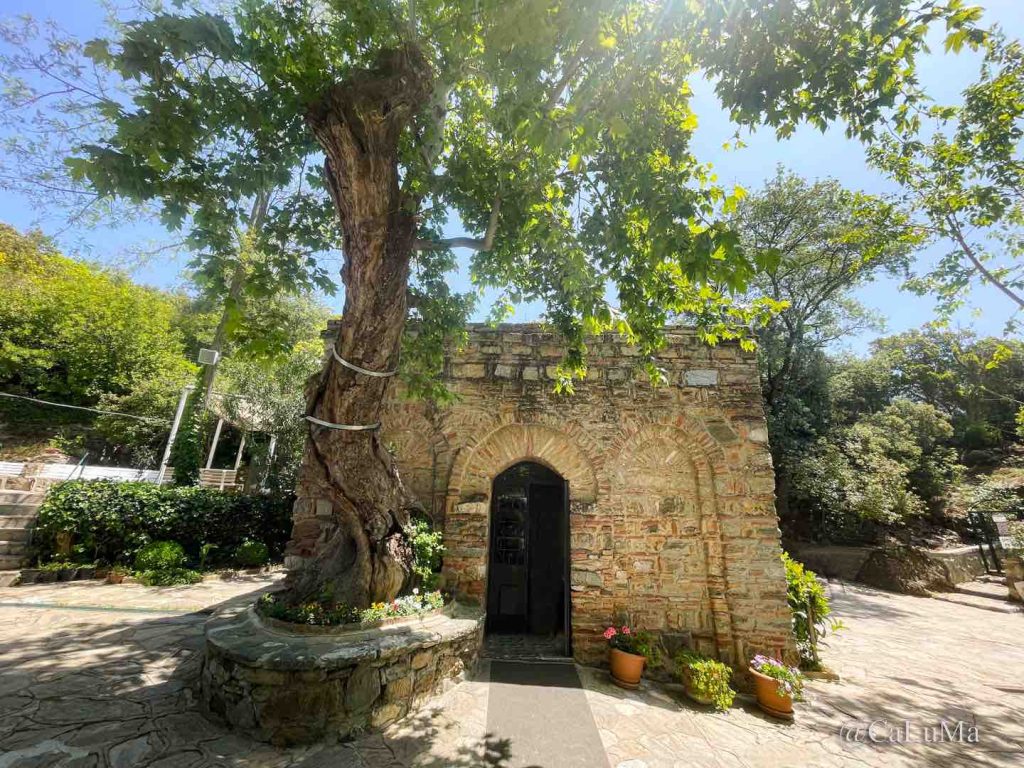
[1] The Holy Bible: John 19, 26-27
[2] “The Council of Ephesus was the third ecumenical council and took place in 431 in Ephesus, in Asia Minor, during the reign of Theodosius II; the Council, attended by approximately 200 bishops, mainly dealt with Nestorianism. Its proceedings took place in a heated atmosphere of confrontation and recriminations. Nestorianism emphasized the human nature of Jesus at the expense of the divine nature. The council condemned as erroneous the teachings of Nestorius (Patriarch of Constantinople), according to whom the Virgin Mary gave birth to a man Jesus, not to God, not to the Logos (The Word, Son of God). The Logos resided in Christ, was kept in his person as in a temple. Christ was therefore only Theophoros, a Greek term meaning “bearer of God”. Consequently, Mary had to be called Christotokos, “Mother of Christ” and not Theotokos, “Mother of God”. Historians have defined the debates between supporters of one position and the other as “christological controversies“. The council decreed that Jesus was one person, not two distinct persons, fully God and fully man, with a rational soul and body. The Virgin Mary is Theotokos because she gave birth not to a man, but to God as man. The union of two natures in Christ was accomplished in such a way that one did not disturb the other.” Source: https://en.wikipedia.org/wiki/Council_of_Ephesus
[3] “In classical mythology, Artemis (identified by the Romans as Diana) is born with her brother Apollo from Leto. Armed with a bow and arrows, she roamed the woods with a retinue of nymphs and was linked to heroes like Orion, Actaeon, and Hippolytus, whom she eventually brought to ruin. It was also believed that Artemis caused death by means of her arrows… Artemis was invoked by women at the time of childbirth; maidens sacrificed to her before marriage, and young men dedicated their locks of hair to her. Linked to the wild nature – rivers and springs were sacred to her too – that is, to a sphere opposite to that of daily existence, and connected to moments of individual existence crisis (birth, death, marriage, entry into adulthood), she embodied in her very figure as a virgin goddess the particular existential condition that precedes maturity. Artemis was well-suited to oversee certain complex rituals against the background of which the original initiatory ceremonies can be recognized: the cult of Artemis in Sparta was typical, during which boys were ritually whipped as they raced towards the goddess’s altar” Source: https://www.treccani.it/enciclopedia/artemide/
[4] “The Library of Celsus is a Roman library built in Ephesus in Anatolia during the Trajanic era in honor of Tiberius Julius Celsus Polemaeanus, a distinguished figure from the city of Ephesus who held all the offices of the Roman cursus honorum (he even held the position of Proconsul of Asia in 106 and died shortly before 117). The building was constructed by Celsus’ son, Gaius Julius Aquila, who bequeathed the city of Ephesus the denarii to purchase the books.”
Source: https://en.wikipedia.org/wiki/Library_of_Celsus
[5] The original statues are in the Ephesos Museum in Vienna
[6] The tradition of the sleepers is not exclusive to the Christian world. Also in Islam it plays a central role, as the story that gives title to a sūra of the Quran, the nineteenth, known as “sura of the cave“. The sura, among the most relevant even for non-Muslim readers, contains two other important narrative cores: one dedicated to the encounter of the prophet Moses with a mysterious figure (Al-Khidr) and one to Dhu al-Qarnayn. The sura is thus a strong connecting element between traditions of the book and European, Mediterranean, and Asian myths.
“And you would think them awake, while they were asleep. And We turned them to the right and to the left, while their dog stretched his forelegs at the entrance. […] So, they stayed in their cave three hundred years, and add nine more.” (Quran, sura XVIII:18, 25). Source: https://en.wikipedia.org/wiki/Seven_Sleepers
[7] For further reading: https://www.vatican.va/news_services/liturgy/saints/ns_lit_doc_20041003_emmerick_it.html