Italian

The exhibition also dedicates an interesting in-depth study on the City of Gold, a settlement dating back to the reign of Amenhotep III and Akhenaten, which emerged thanks to an exceptional archaeological dig, whose finds provide a unique insight into Egyptian society, daily life, and the practices of the artisans serving the court, who, with their skill, helped to shape history.


The exhibition, accompanied by a catalog curated by Dr. Zahi Hawass, is also enriched by a calendar of events, including lectures, guided tours, and educational workshops for adults and children, to deepen the understanding of Egyptian culture through an accessible and exciting experience.


The audioguide, available for free download via a QR Code, features the voice of Alessandro Giacobbo, the television host of Fredoom, Beyond the Border, who often collaborates with Dr. Zahi Hawass, of whom he has also become a dear friend.
A journey between mystery and wonder, that will amaze you, born from the precious collaboration between two nations, aiming to tell the story of a fascinating society, with its still unresolved mysteries and around which, therefore, studies are continuously evolving.
The exhibition will be open until May 3 every day. Don’t miss the chance to visit it, perhaps taking advantage of one of the upcoming spring holidays (April 25 – May 1).

Among the exceptional exhibits on display is also the Mensa Isiaca, coming from our museum.
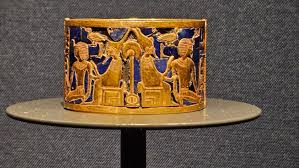
This extraordinary bronze table, made in the 1st century BC using the lost-wax casting technique and finely decorated with inlays of copper, silver, and niello, is today interpreted as a visual representation of the Greek hymns dedicated to the worship of Isis, celebrated in Rome.
According to the most accredited hypothesis, the Mensa Isiaca was originally located in the Iseum Campense, that is, the temple of Isis in the Campus Martius. The worship of the goddess Isis was introduced to Rome as early as the 2nd century BC, when the Romans, expanding into the eastern Mediterranean, intercepted the admiration that the Greeks had for the civilization of the Nile since the time of Herodotus (5th century BC).
The exhibition, therefore, the result of a prestigious collaboration between Italy and Egypt that celebrates the value of cultural diplomacy, retraces the fundamental stages of Egyptian civilization, from its origins to the golden age of the great pharaohs of the New Kingdom and the Third Intermediate Period.
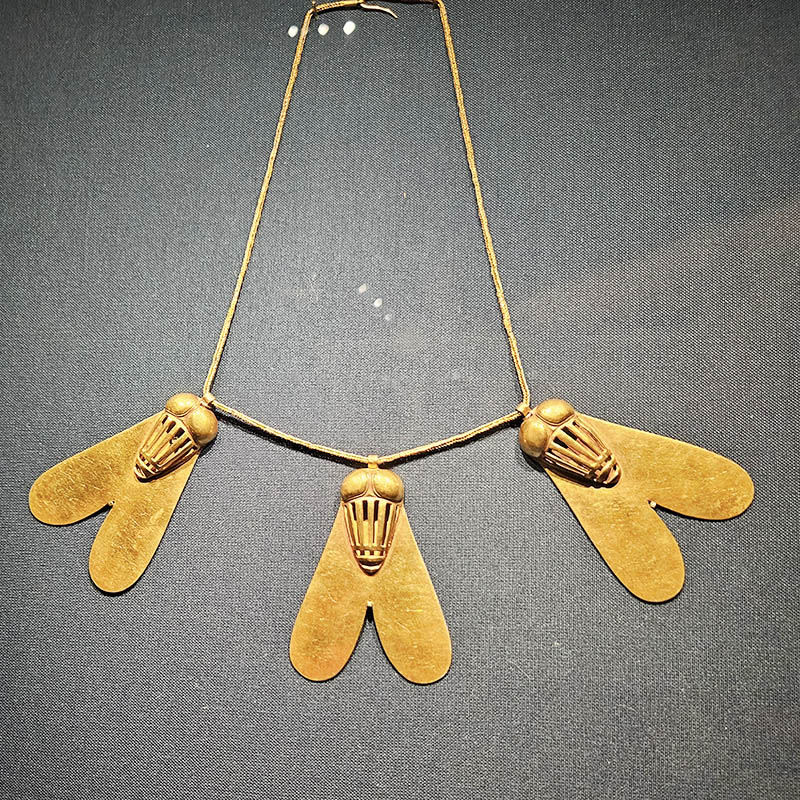
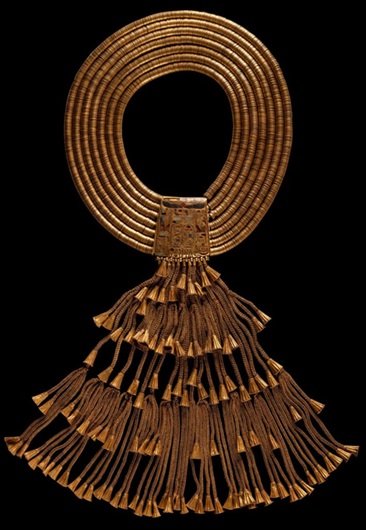
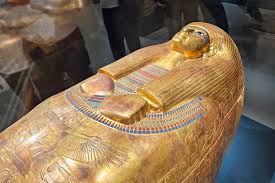
Among the exhibited works are the monumental sculpture of the Triad of Mycerinus (Old Kingdom), the golden sarcophagus of Queen Ahhotep (New Kingdom), the Golden Fly Necklace of Queen Ahhotep, the golden funerary mask of Amenemope, the golden sarcophagus of Thuya, grandmother of Pharaoh Akhenaten, the golden funerary cover of Pharaoh Psusennes I (Third Intermediate Period), the statues of Sennefer, Ramses VI, and Thutmose III, along with royal jewelry, everyday objects and sarcophagi adorned with sacred symbols.
The exhibition also dedicates an interesting in-depth study on the City of Gold, a settlement dating back to the reign of Amenhotep III and Akhenaten, which emerged thanks to an exceptional archaeological dig, whose finds provide a unique insight into Egyptian society, daily life, and the practices of the artisans serving the court, who, with their skill, helped to shape history.
The exhibition, accompanied by a catalog curated by Dr. Zahi Hawass, is also enriched by a calendar of events, including lectures, guided tours, and educational workshops for adults and children, to deepen the understanding of Egyptian culture through an accessible and exciting experience.
The audioguide, available for free download via a QR Code, features the voice of Alessandro Giacobbo, the television host of Fredoom, Beyond the Border, who often collaborates with Dr. Zahi Hawass, of whom he has also become a dear friend.
A journey between mystery and wonder, that will amaze you, born from the precious collaboration between two nations, aiming to tell the story of a fascinating society, with its still unresolved mysteries and around which, therefore, studies are continuously evolving.
The exhibition will be open until May 3 every day. Don’t miss the chance to visit it, perhaps taking advantage of one of the upcoming spring holidays (April 25 – May 1).
The Pharaohs Exhibition at the Quirinal Stables
Ancient Egypt never ceases to fascinate.
The ongoing exhibition at the Scuderie del Quirinale, which focuses in particular on the Pharaohs, is a testament to this.
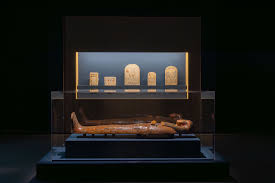
The exhibition features over 130 artifacts, many of which come from the Cairo Museum and have never been seen before in Italy, including statues, sarcophagi, and jewelry, such as the sarcophagus of the noblewoman Tuia.
In fact, even for those who have already visited the Egyptian Museum in Turin or even the old setup of the Cairo Museum, the arrangement and the pieces displayed in this exhibition will be a surprise.
Also the choice to display the pieces in a way that allows them to be fully appreciated, because they are not chosen in quantity, but for quality.
Curated by Dr. Tarek El Awady, the Treasures of the Pharaohs is an extraordinary and unique event to admire exceptional works and artifacts, including some displayed for the first time in Italy: this is indeed the second time that Egypt has authorized such an impressive exhibition after the one in the early 2000s at Palazzo Grassi in Venice.
The exhibition path unfolds in six thematic sections, telling the story of a timeless civilization – the divine role of the pharaohs, social organization, spirituality, afterlife rituals, and the most recent archaeological discoveries – featuring masterpieces on loan from the most illustrious Egyptian museums, such as the Egyptian Museum in Cairo and the Luxor Museum, along with the contribution of the Egyptian Museum of Turin with a valuable artifact.
Among the exceptional exhibits on display is also the Mensa Isiaca, coming from our museum.
This extraordinary bronze table, made in the 1st century BC using the lost-wax casting technique and finely decorated with inlays of copper, silver, and niello, is today interpreted as a visual representation of the Greek hymns dedicated to the worship of Isis, celebrated in Rome.
According to the most accredited hypothesis, the Mensa Isiaca was originally located in the Iseum Campense, that is, the temple of Isis in the Campus Martius. The worship of the goddess Isis was introduced to Rome as early as the 2nd century BC, when the Romans, expanding into the eastern Mediterranean, intercepted the admiration that the Greeks had for the civilization of the Nile since the time of Herodotus (5th century BC).
The exhibition, therefore, the result of a prestigious collaboration between Italy and Egypt that celebrates the value of cultural diplomacy, retraces the fundamental stages of Egyptian civilization, from its origins to the golden age of the great pharaohs of the New Kingdom and the Third Intermediate Period.
Among the exhibited works are the monumental sculpture of the Triad of Mycerinus (Old Kingdom), the golden sarcophagus of Queen Ahhotep (New Kingdom), the Golden Fly Necklace of Queen Ahhotep, the golden funerary mask of Amenemope, the golden sarcophagus of Thuya, grandmother of Pharaoh Akhenaten, the golden funerary cover of Pharaoh Psusennes I (Third Intermediate Period), the statues of Sennefer, Ramses VI, and Thutmose III, along with royal jewelry, everyday objects and sarcophagi adorned with sacred symbols.
The exhibition also dedicates an interesting in-depth study on the City of Gold, a settlement dating back to the reign of Amenhotep III and Akhenaten, which emerged thanks to an exceptional archaeological dig, whose finds provide a unique insight into Egyptian society, daily life, and the practices of the artisans serving the court, who, with their skill, helped to shape history.
The exhibition, accompanied by a catalog curated by Dr. Zahi Hawass, is also enriched by a calendar of events, including lectures, guided tours, and educational workshops for adults and children, to deepen the understanding of Egyptian culture through an accessible and exciting experience.
The audioguide, available for free download via a QR Code, features the voice of Alessandro Giacobbo, the television host of Fredoom, Beyond the Border, who often collaborates with Dr. Zahi Hawass, of whom he has also become a dear friend.
A journey between mystery and wonder, that will amaze you, born from the precious collaboration between two nations, aiming to tell the story of a fascinating society, with its still unresolved mysteries and around which, therefore, studies are continuously evolving.
The exhibition will be open until May 3 every day. Don’t miss the chance to visit it, perhaps taking advantage of one of the upcoming spring holidays (April 25 – May 1).