Italian

We need to spread a culture of peace that necessarily requires sacrifice and effort. By activating ourselves to spread it. We must become ambassadors of peace with the people and places we frequent.” These are the words of Paola Zuliani contact person for the Venice group of the Centesimus Annus pro Pontifice Foundation drawing the conclusions of the meeting that took place in the “Cardinal G. Urbani” center in Zelarino-Venice


ZELARINO (VE). Conclusions that actually have the flavor of a program that looks to the future precisely because it is an invitation addressed to everyone to be promoters of peace every day. The meeting was organized by the Venice and Treviso groups (contact person Pietro Piccinetti) of the Centesimus Annus pro Pontifice Foundation (FCAPP) to discuss the role of diplomacy in peacebuilding.


The event, coordinated by the Foundation’s Venetian contact person Paola Zuliani, was part of the cycle of events dedicated to artificial intelligence and politics, inspired by Pope Francis’ Encyclical “Brothers All.” AI is certainly one of the most relevant technological challenges, as it has profound social, community and political implications. The Pontiff in his speeches stressed several times that AI should not replace human relationships, nor be deified, but should remain a tool at the service of man.

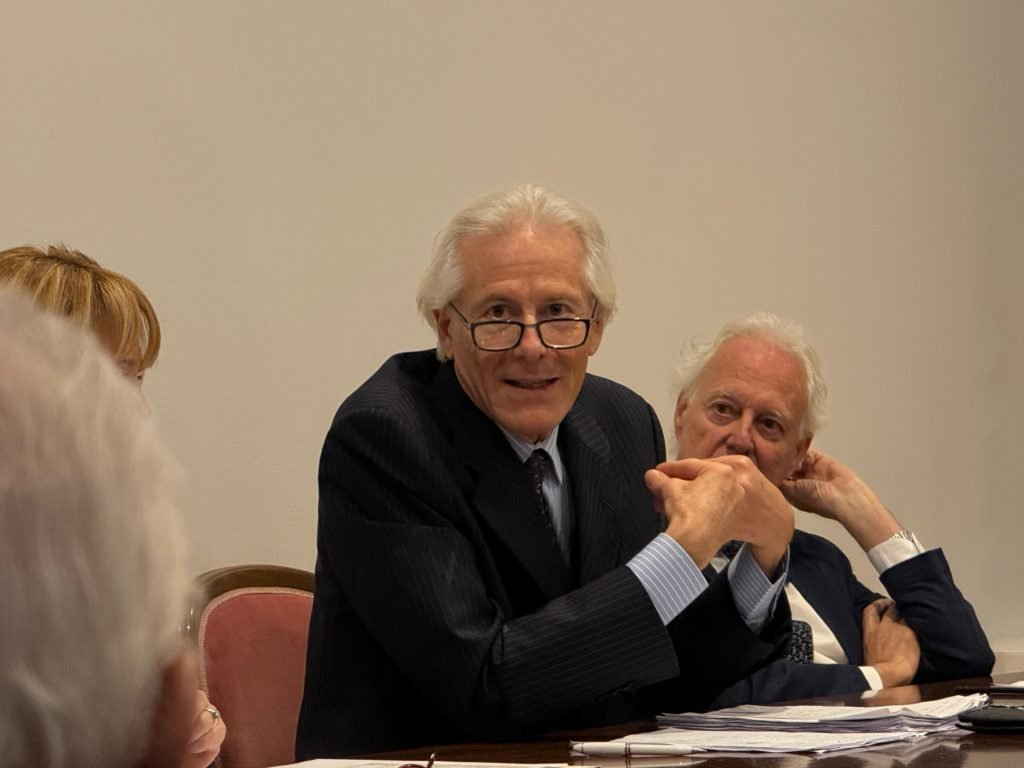


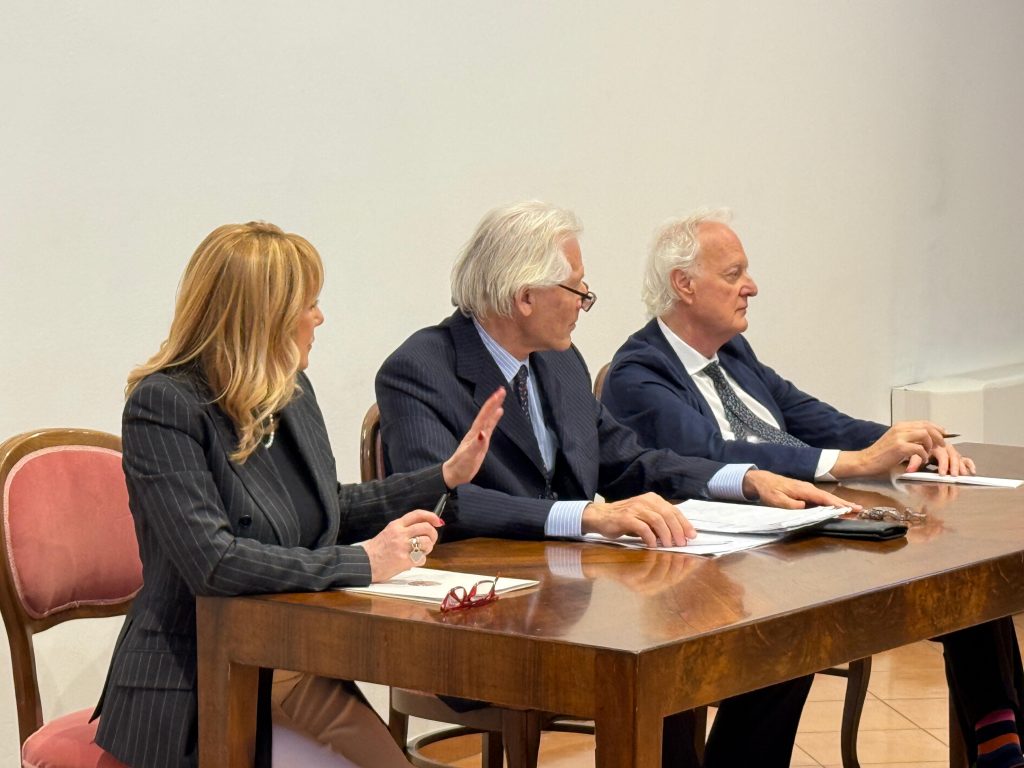
The speakers: Patrizio Fondi and Sergio Barbanti
Based on these insights, the central theme of the meeting developed, which focused precisely on the art of diplomacy to build peace. Two prominent figures in international diplomacy set the pace for the event: Ambassador Patrizio Fondi and Ambassador Sergio Barbanti.
Patrizio Fondi, a career diplomat with the rank of Ambassador, has held key positions in numerous international contexts, including the Embassy of the European Union, in the United Arab Emirates and at the Embassy of Italy in Jordan. Currently, he holds academic positions at the Universities of Bologna and Rome “Tor Vergata,” as well as being a member of the Board of Directors of the Italy-Gulf Initiative (IGI).
Ambassador Fondi offered the audience who spoke for the occasion a broad reflection on the use of artificial intelligence (AI) in international relations. In particular, he stressed that in an era such as the one we are living through made up of great changes, the use of AI must necessarily be geared toward peacebuilding. For a diplomat, any tool that facilitates this goal is welcome, as long as it is not overstated. Indeed, technology cannot replace human beings in moral, psychological and strategic choices.
The Ambassador pointed out that if used judiciously, AI speeds up decision-making processes, but must always remain under human control to avoid dangerous consequences, especially in international relations, defense and security. Fondi then continued his reflection by highlighting that AI also has a predictive function that is useful in preventing conflicts. Indeed, by analyzing geopolitical, economic, military, and cultural factors, it is possible to identify areas at risk of war, such as those related to water management that could involve Egypt and Sudan or even in relation to existing tensions between India and neighboring countries.
However, it must be said that already in the past, analysts have predicted events such as the Soviet invasion of Afghanistan in 1979. However, it must be remembered that prediction is not certainty and human intelligence remains crucial. For all these reasons, the Ambassador brought up the theme that in order to manage AI properly, proper international governance must be in place. The United Nations, with the leadership of Secretary General Guterres, is working on regulations to limit the use of autonomous weapons. Other international bodies such as the G7, the European Union and NATO are also developing regulations for the military and civilian sectors.
However, regulating a rapidly evolving technology is complex. Unlike nuclear weapons, for which there are transparent agreements on their number and type, AI in this respect is more difficult to control, as revealing its capabilities could render them ineffective. All this calls for sophisticated regulation and constant monitoring. The challenge is great, but addressable through good cooperation and strategic vision at the international level.
Ambassador Sergio Barbanti, also a longtime diplomat, has served in a variety of international fora, including the United States, NATO, and Ambassador to Austria and the Balkans (Montenegro). From 2021 to 2024, he served as Italy’s Ambassador to Israel and experienced firsthand the tragic events surrounding the October 7, 2023 Hamas attack. Barbanti offered firsthand testimony on those dramatic events that triggered a war whose end is yet to be seen.
Israel since independence in 1948 has faced several attacks, such as the Yom Kippur War, but none like the one on Oct. 7 has so deeply scarred its soul. The atrocity of the acts carried out, documented by the terrorists themselves, has left the country appalled, the Ambassador said. He added that the images disseminated are horrific and unbearable to watch. Events did not stop with the initial massacre: more than 250 people, including not only Israelis but also foreigners, were kidnapped and taken to Gaza. And it is with this action that the term “hostages” has taken on a different meaning. Hostages are considered means of exchange in negotiations, while this time they were victims of pure hatred. Barbanti, remembering that Israel was born to protect the Jewish people from new massacres found itself instead living a nightmare that called into question its security. Many citizens wondered how it was possible to fail to defend civilians.
For a people persecuted for centuries and who had found in their land a refuge thought to be safe, the October 7 attack was devastating. The State of Israel known for its excellent military capabilities and intelligence efficiency, was brought to its knees by an enemy thought to be weak, who broke through Gaza’s barriers with bulldozers, taking everyone by surprise. This event deeply wounded not only Israel but also the Jewish diaspora around the world. It rekindled traumas of past persecution. This was not a political conflict, but an attack on people killed simply because they were Jewish. Ambassador Barbanti recounted that among the victims, were those who lived on kibbutzim near Gaza and who believed more than others in peace and integration between the two peoples. All that violence challenged the deterrence capacity of the Jewish state. That was the doubt and fear that crossed the faces and feelings of the citizens of Israel.
The two speeches stimulated a lively debate with the audience, offering valuable insights into how artificial intelligence and diplomacy can coexist, without ever losing sight of the irreplaceable value of the human element, making peace builders. Guests who took part in the event included FCAPP board member Maurizio Gallo, Prof. Carlo Adami, Verona group liaison, and Centesimus Annus Foundation Secretary General Oliver Galea.