Italian

After Istanbul, Pergamon, and Ephesus, our journey continues towards other destinations of great value from an archaeological and not only perspective. Aphrodisias, Hierapolis, Laodicea await us, and then Konya, the Cotton Castle, with their stories, their culture, their natural beauties.
The ancient city of Aphrodisias was inhabited, as archaeological excavations reveal, already during the Bronze Age, between 2300 BC and 950-800 BC. At the entrance of the archaeological park, a series of beautiful sarcophagi finely carved with faces and decorations of great value have been placed.
Aphrodisias, dedicated to the goddess of love and beauty, Aphrodite, was a city of the Hellenistic period that continued to develop during Roman and then Byzantine rule.


Texts, photos, and videos by Carlo Franchini


It was a city well known as a center of sculptural art that influenced the entire Greco-Roman world, as evidenced by the many marble statues signed by the artists of this school and found throughout the Roman world, in Spain and Germany[1]. The first thing that appears in all its beauty is the Tetrapylon, the monumental gateway to the great temple of Aphrodite.
It is believed that this monument of great value and elegance was built in the 2nd century AD. The very white color of the columns and the contrast with the blue sky create a magical sight to behold in silence. I imagine the many visitors, pilgrims, and faithful who passed through this gate on their way to the grand temple. I think of their voices, the sounds of their footsteps on the pavement. I imagine the wonder of those who admired such beauty for the first time, their hopes and supplications to the goddess.
Not far away, in all its grandeur, is the Aphrodisias Stadium from the 1st century AD.
Measuring 270 meters long, 60 meters wide, with 30 rows of marble seats that could accommodate over 30,000 people.
At the stadium, athletic competitions, races, and other disciplines were held, as well as gladiatorial combats. Later on, the stadium was also used for theatrical performances… A recent investigation has shown that this conversion of the stadium into an amphitheater was done in 400 AD. The seating areas preserve a fascinating body of “locative” inscriptions carved on the marble seats, allocating space to various groups (such as tanners’ and goldsmiths’ associations) and to wealthy individuals (both men and women) from Aphrodisias and neighboring communities like Antioch on the Meander. Spectators mapped their social and political affiliations onto the seats of this grand public forum.“[2]
The theater, dating back to 27 B.C., is also well preserved, as well as the charming odeion or bouleuterion used for concerts, poetry recitations, and political, musical, and poetic conferences. Often, it was also used for lectures by rhetoricians and philosophers, as well as for political meetings. Lastly, we move among the well-preserved fourteen columns of the temple of Aphrodite, from the 1st century B.C. Similar to other pagan temples, in 50 A.D. it was converted into a Christian basilica.
Leaving the site, after a walk uphill along wheat fields where the swaying spikes are moved by the wind, we reach the beautiful and refined theater of Hierapolis, built during the Roman period (14 A.D. – 68 A.D.).
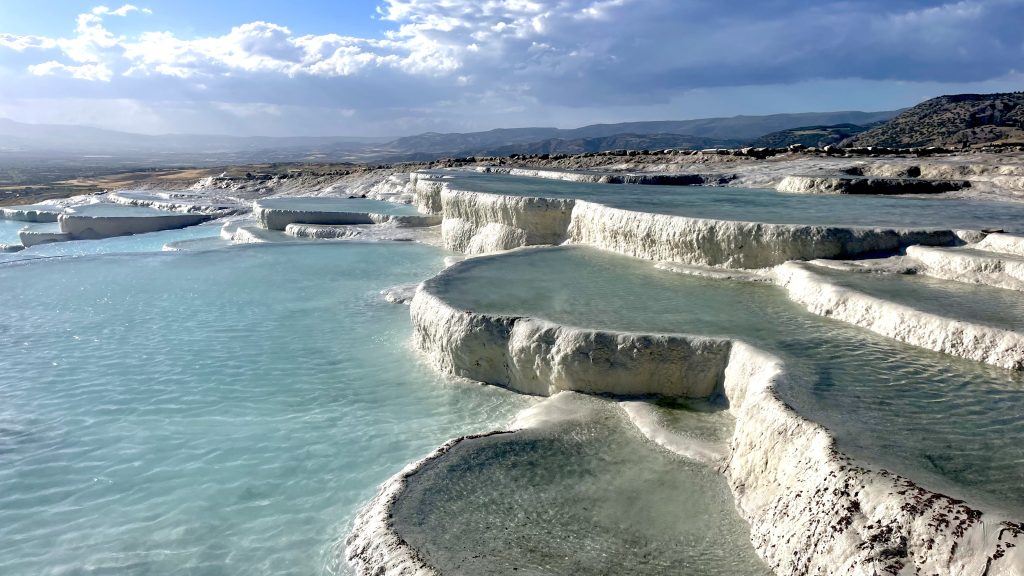
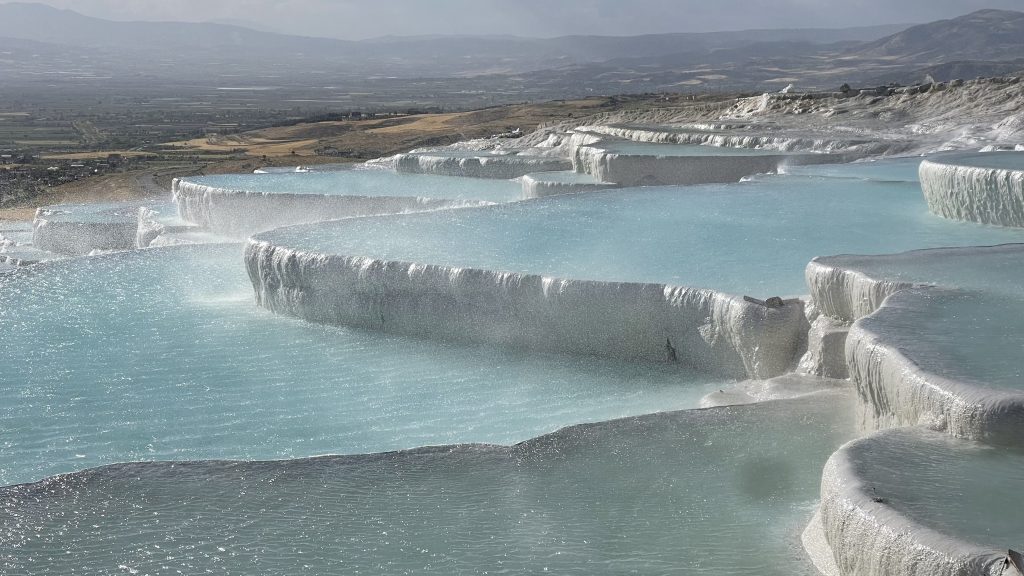
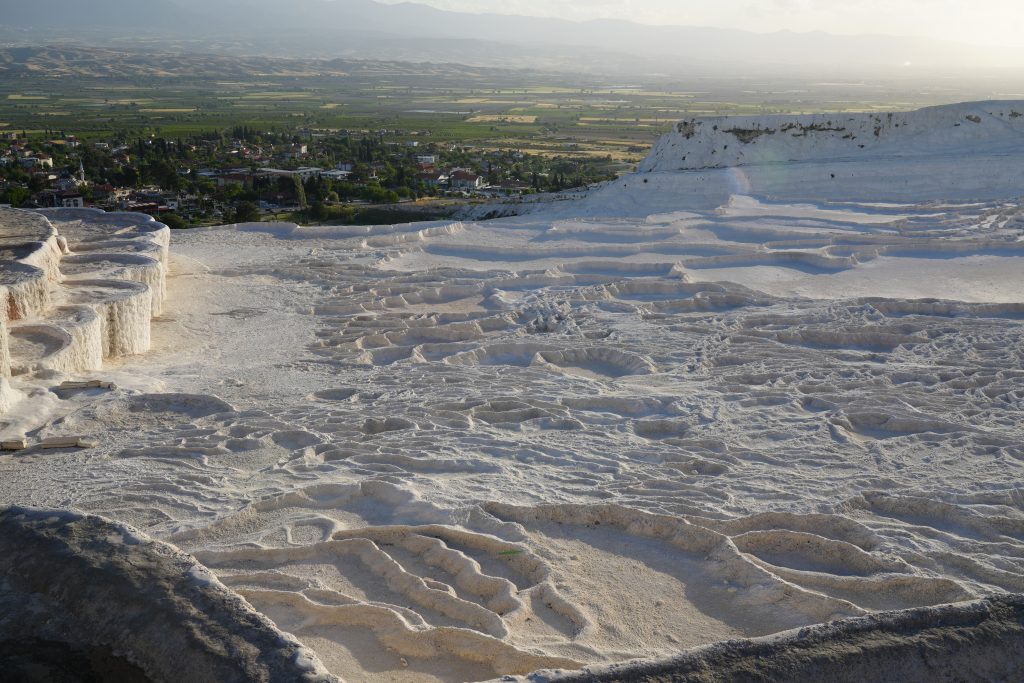
Returning downstream, we visit the ancient monumental tombs of various shapes. But before leaving the site, we are greeted by a wonder this time offered by nature… the “Cotton Castle.” This is the term used to describe the white limestone pools where crystal-clear thermal water flows from underground, creating a wonderful display of colors between white and azure… “Tectonic movements have, on one hand, caused frequent earthquakes, but they have also allowed the birth of numerous thermal springs, still in use today, where water, saturated with calcium ions and carbon dioxide, combines with water creating carbonic acid.
Then, as it emerges, the water loses much of the carbon dioxide, giving rise to calcium carbonate which, also due to the lowering of temperature, precipitates giving rise to fantastic landscapes, with thick white layers of limestone and travertine along the mountain slope, making the area resemble a fortress of pure cotton or cascades of opaque ice.”[3]
The next stop is the ancient city of Laodicea, in the Lycus River valley.
The city was founded by Antiochus II Theos, ruler of Syria, in honor of his beloved wife Laodice at a location previously called Diospolis. Around the 1st century B.C., Laodicea became famous for its textiles, footwear, and medicines. Mentioned in the Book of Revelation and the site of a council in 350, it was completely destroyed by an earthquake in 494 and never rebuilt. What remains, the main street, the columns of the temple are very well preserved in a unique and pristine landscape.
Our journey continues to the town of Konya where we visit the famous Mevlana Museum.
The name Mevlana which means “our guide,” was given to the most famous mystical philosopher in the world, Jalal ad-Din Rumi. Author of numerous lyrical poems collected in the book Dīvān-e Kabīr composed of 40,000 verses written in Persian and the poem “Masnavi” composed of 25,000 verses, Mevlana taught respect and tolerance as evidenced by some verses he wanted to be written near his mausoleum…”Come, come, whoever you are, even if you are an unbeliever, a pagan, or a fire-worshipper, come. Ours is not a brotherhood of despair. Even if you have broken your repentance vows a hundred times, come.”
We reach the mausoleum whose main dome is entirely covered with turquoise tiles and enter through the ancient Ottoman door where the inscription is carved… “Whoever enters here incomplete, will leave perfect“. The tomb of Mevlâna is close to that of his son Sultan Veled and other important followers. The sarcophagi are covered with drapes embroidered in gold and on some of them rest large colorful turbans that “symbolize spiritual authority; the number of twists in the turban represents the spiritual importance of the owner“.[5] There are many people because this mausoleum, a pilgrimage destination, is particularly sacred for Muslims. It is truly an evocative and mystical place. A loud thunder announces the storm that is pouring down on the city, so we leave the site, concluding a truly special day during which we visited numerous significant landmarks of the ancient history of this land.
We leave Konya early in the morning heading to Cappadocia, and reach the Sultanhani Caravanserai (13th century), a resting place for caravans traveling on the “Silk Road” which today is a museum housing beautiful antique Turkish carpets. Then we arrive in Cappadocia, the last important destination of our journey. We visit the underground city of Aziz Mercurios Yeralty, one of the 200 underground cities of Turkey.
The city, built on seven levels, a masterpiece of engineering, takes the name of San Mercurio (225-250 AD) and certainly like the other underground cities, it was excavated in order to protect the populations from continuous invasions.
Huge rotating stones hermetically sealed the various entrances to the city inside which nothing was missing as evidenced by the findings of millstones, water wells, tools for the production of wine and oil.
The various rooms are connected by galleries made in such a way as to disorient a potential enemy that managed to penetrate.
The light inside is very dim and the guide’s voice echoes among the rock walls.
One cannot help but think in what difficult conditions those people lived but still safe from the many dangers of the time.
We leave the site at dusk. The sky is covered with large threatening clouds that let only a few rays of sunshine filter through, and the charming town of Urgup welcomes us. I try to remember the many things we have seen but my mind alternates between many images of extraordinary places, of experiences lived that I struggle to put in the right order. So, I rely on my precious travel diary until late at night without realizing it. But then it’s time to sleep, tomorrow the heart of Cappadocia awaits us, its spires, its monuments, its enchanted places.
Wake up at 4 in the morning and half an hour later we are on the off-road vehicle with which our guide will take us to the most engaging places in this unique territory.
Leaving the paved road, after about 1 hour we are on a track that in a few minutes leads to the first spectacular pinnacles that are rapidly illuminated by the rising sun.
A fox crosses the space between two large pinnacles then stops, looks at us, and resumes its run. “Brings luck,” says the guide. “It’s not easy to see them, but without other cars around, foxes feel safer and come out in the open!” Those who know Cappadocia will wonder why I’m not talking about the most famous tourist attraction in this place… the hot air balloon flight. I’m not interested, both because of the large influx of tourists and because, being able to stay only one day, I prefer to observe closely, for as long as I want, the views of this wonderful landscape. And then… I have no regrets… fate has decided that today the wind did not allow the hot air balloons to fly! So all the tourists, after a few hours of waiting at the take-off field, had to return.
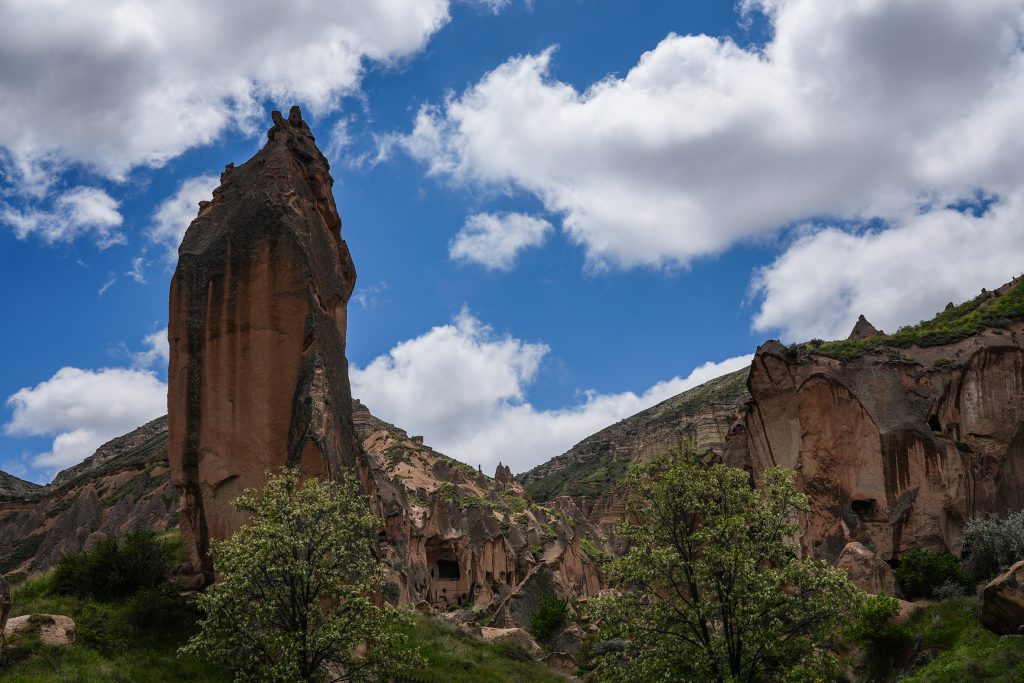
For this reason too, we are alone, surrounded by a silence interrupted only by the blowing of the wind! Pinnacles of all shapes rise around us, some are carved, a sign of human presence in the past. In this area, in fact, there are numerous shelters and rock churches carved over the centuries.
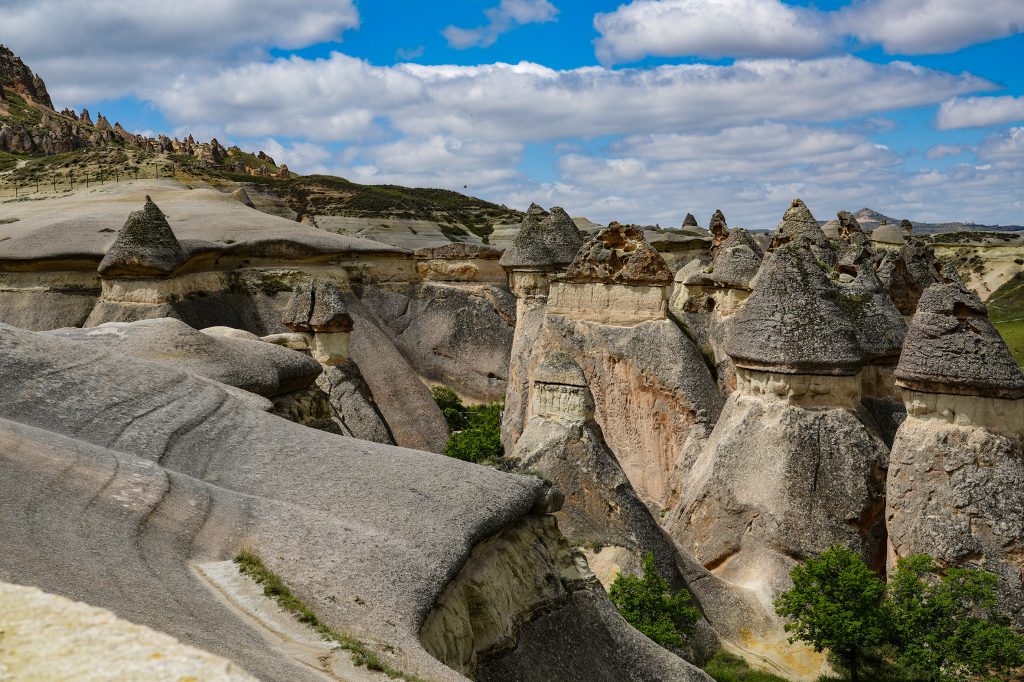
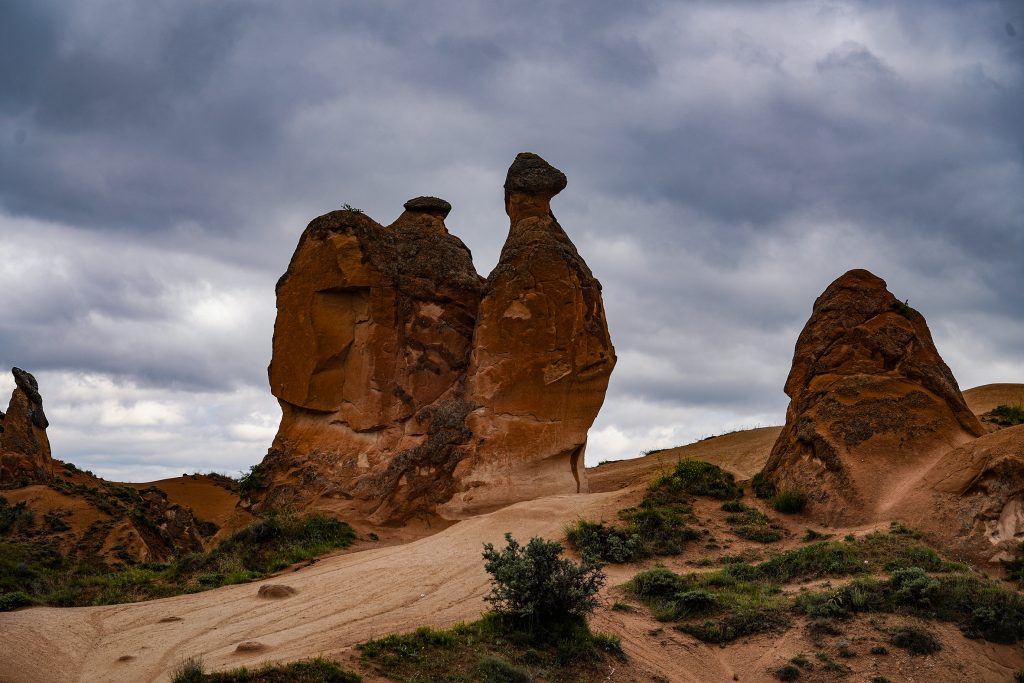
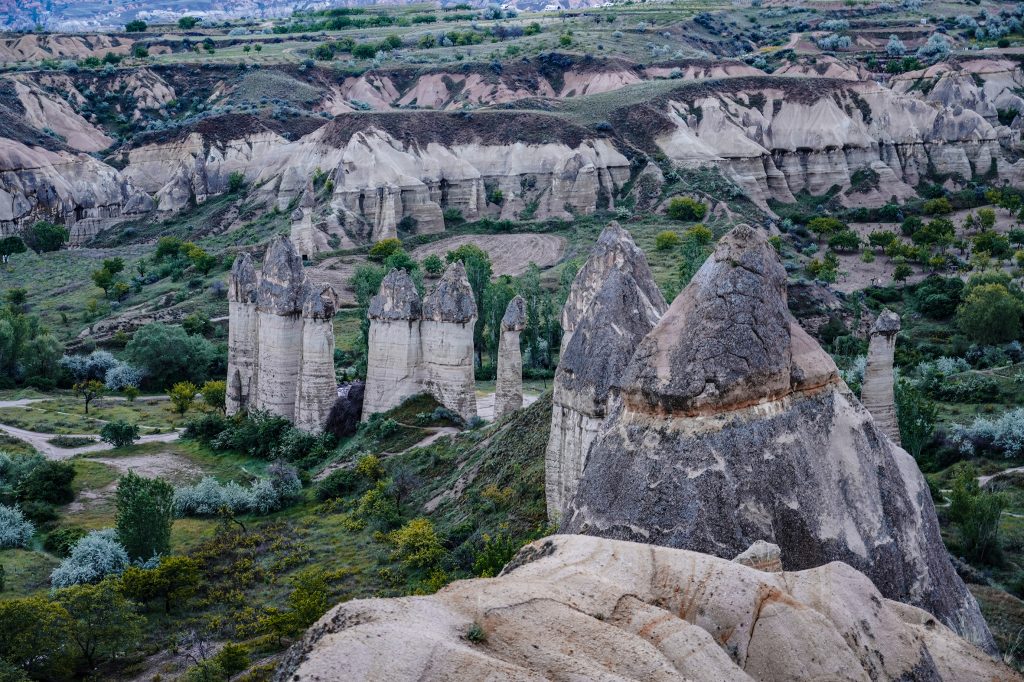
We are facing a geological phenomenon where nature seems to have unleashed its creativity with implications for humans, stimulating imagination and curiosity…
I ask my geologist friend Marialuisa Ronconi, who is traveling with us, about the reason behind these strange formations… “The region of Cappadocia occupies the central part of Anatolia with its vast plateau surrounded, 10 million years ago, by volcanoes of tertiary origin, now extinct, arranged along the major fractures that still affect the region today. The eruptions of these volcanoes have sculpted unique landscapes and laborious masterpieces formed by successions of rocks deposited during three main periods of eruptive activity that filled, with magma and ashes, the ancient erosion basins transforming the Anatolian plateau into a tableland. The solidified ashes gave rise to tuff, a rock easily subject to erosion by atmospheric agents and often cracked by thermal variations, allowing water to seep in, erode the rock, and form canyons, cones, chimneys, and other typical formations of the region.
Human settlements have been established on these geological forms, digging dwellings arranged on multiple levels as well as cliffside villages and rock-cut churches, when the Anatolian peninsula, like the Southeastern Mediterranean, experienced a dry phase with rising temperatures. This suggests that it was the microclimate of the artificial cavities, used for various functions, that led to the excavation work during that specific historical period.
Therefore, human hands have added beauty to the creative perfection of a nature that has devoted itself to designing bizarre masterpieces in Cappadocia, aided by wind, rain, ice, and millennia. Its unique landscapes offer a true journey around the world in just a few hours, displaying deep canyons, caves, cavities, but above all magical and colorful pyramids, reaching up to 45 meters high, with their tips crowned by large boulder-like rocks resembling hats called fairy chimneys, because the early inhabitants of Cappadocia believed they were the chimneys of fantastic creatures living in the depths of the Earth, and UNESCO has included them among the world’s heritage.” [6]
Here are the pyramids with their summits topped by large boulder-like stones, as if delicately placed. In some areas, the pyramids are grey with streaks of green and orange from the lichens that form on the walls. Not far away, in the Devrent Valley, towers and pinnacles have an ochre color, like the earth from which they seem to emerge, offering bizarre sculptures carved by the wind. They are all places that have been given fanciful names… the Valley of Love, the Valley of Swords, the Valley of the Pigeons, the Valley of Roses, the Pasabaq Valley, or the Valley of the Monks with different erosions.
Finally, we visit the Goreme Valley, a true open-air museum as it is commonly called. The Goreme Valley houses 7 wonderful rock churches from the 6th-13th centuries AD, decorated with beautiful Byzantine-style paintings that have been affected by time and signs of vandalism after the churches were abandoned. However, various recovery activities are underway by archaeologists.
Today is the last day in wonderful Turkey. Before leaving, we attend the Holy Mass officiated by the spiritual guide traveling with us, in an evocative hypogeal church atop a hill overlooking a vast valley. The mystical and spiritually rich atmosphere induces reflection and contemplation. Cross sculptures on the walls stand out as witnesses of a distant time.
[1] Source: https://www.allaboutturkey.com
[2] Source: https://www.romanoimpero.com
[3] Source: https://www.romanoimpero.com
[4] Source: https://en.wikipedia.org
Jalāl ad-Dīn Muhammad Rūmī, also known as Jalāl ad-Dīn Muhammad Balkhī, and in Iran and Afghanistan commonly known as Mowlānā and Molavī (Balkh, September 30, 1207 – Konya, December 17, 1273), was a Sunni Muslim scholar, theologian, and Central Asian Persian mystic poet, known as one of the greatest authors of Persian mystical literature.
After his death, his followers organized rituals in which they attempted to reach meditative states through ritual dance and music, (in which the predominant sound was that of the ney flute, praised by Rumi in the prologue of his Masnavi).
[5] Source: https://www.lonelyplanet.com
[6] Maria Luisa Ronconi, Full Professor of Geography, Department of Humanities, University of Calabria – GEOLab Laboratory of Geography applied to the territory and landscape